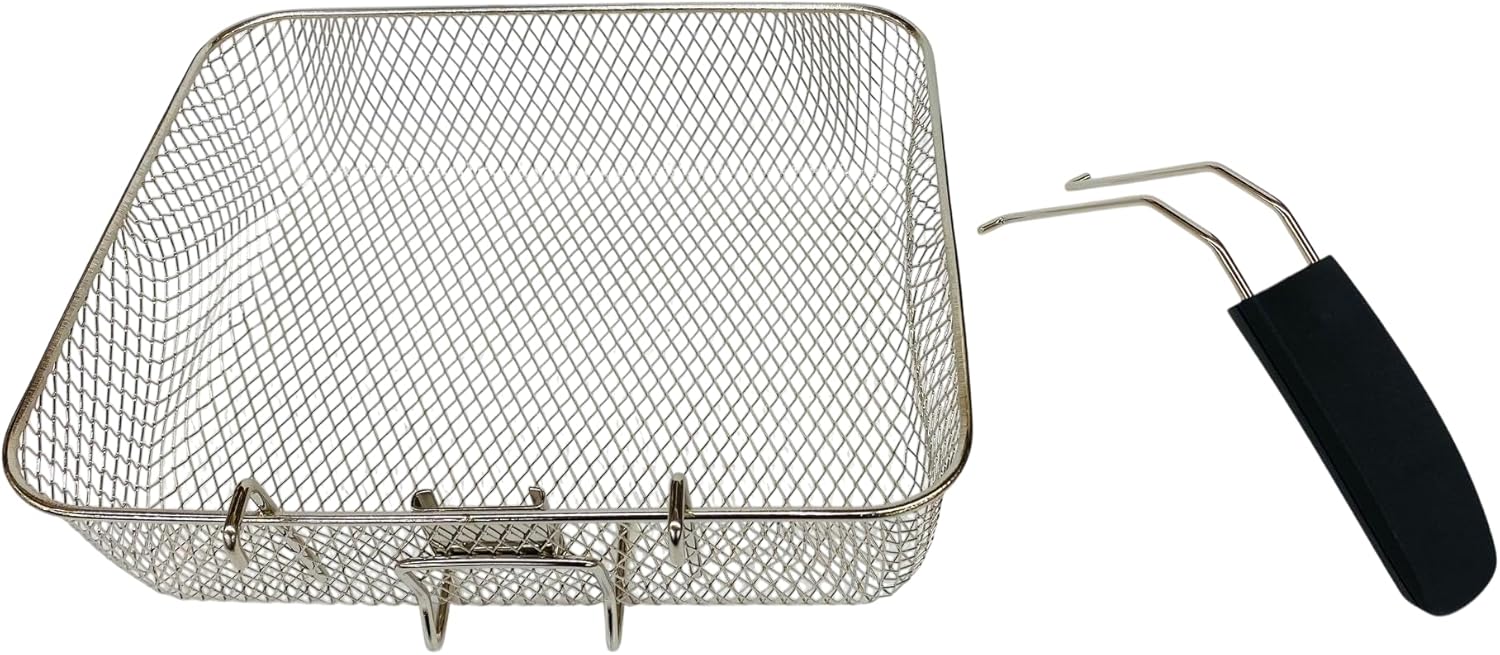
Your countertop electric fryer’s basket just gave up — the handle snapped, the mesh pulled away from the frame, or it simply went missing in a move. Now you’re staring at a model number on a sticker and wondering why a replacement basket is either impossible to find, eye-wateringly expensive for what it is, or listed as “universal” when it clearly won’t fit. You are not imagining things. This is one of the most underserved corners of the small-appliance market, and it has a specific, fixable explanation. This guide walks through what makes countertop electric fryer baskets non-interchangeable (even when they look identical), how Presto, Hamilton Beach, and T-fal each handle — or mishandle — the parts ecosystem, and exactly when an aftermarket basket is a smart buy versus a frustrating waste of twenty dollars.
Why “Universal” Almost Never Means Universal
Here is the load-bearing problem: countertop electric fryers are not standardized the way, say, 14-inch pizza pans are. The basket on a countertop unit sits inside an oil vessel (the pot or “fry bowl”) whose interior dimensions vary by brand, model line, and in some cases production year. A basket that is 1 cm too wide will grind against the pot walls and stress the handle attachment point. A basket 1 cm too narrow will tip, drop food underneath it, and give you uneven frying results.
Aftermarket sellers use “universal” to mean “fits the most common oil-vessel footprint” — typically a rectangular vessel in the 3.5- to 5-quart range. What they cannot account for is the lip geometry, the hook or bail-arm hanger profile, and whether the handle is designed to engage a specific locking ridge inside the fryer body. These variables are proprietary and brand-specific, which is exactly why OEM (original equipment manufacturer) replacement baskets exist and why they cost more than the hardware-store logic of “it’s just wire mesh” would suggest.
The practical decision you’re navigating: Is there an OEM replacement still in distribution, is it priced reasonably, and if not, which aftermarket basket is a true drop-in versus a workable compromise that requires minor adaptation?
The Three Major Consumer Brands and Their Parts Reality
Presto
National Presto Industries has a comparatively strong replacement-parts posture for a consumer small-appliance maker. Their GranPappy, FryDaddy, and multi-basket Pro Fry lines each have distinct basket geometries — the GranPappy uses a round, single-piece mesh basket that fits inside a round 6-cup oil capacity vessel, while the ProFry dual-basket units use rectangular stainless-mesh baskets with a bail-arm handle that hooks at a specific height inside the fryer housing.
Per Presto’s own product support documentation for the 05466 Pro Fry Immersion Element model, OEM replacement baskets are listed as separate purchase items on their parts page with defined part numbers. As of mid-2026, Presto OEM basket pricing lands in the $12–$22 range for single-basket models and $28–$45 for dual-basket configurations — expensive relative to what the metal costs, but not unreasonable given that they are guaranteed fits.
The aftermarket gap for Presto is modest for their older round-vessel models (the GranPappy footprint is common enough that several aftermarket round baskets will clear the vessel correctly) but meaningful for the rectangular Pro Fry units, where bail-arm hook geometry matters and few aftermarket products replicate it faithfully.
If your Presto model is still in production: go OEM. The part exists, it ships direct, and you’ll spend less time troubleshooting than you will sourcing an aftermarket equivalent.
If your model is discontinued: measure the interior vessel dimensions (length × width × depth at the point where the basket lip rests) and match that against published aftermarket specs — not the seller’s marketing copy.
Hamilton Beach
Hamilton Beach’s fryer line is larger and more fragmented than Presto’s, which creates a parts-sourcing headache. Their 35034 multi-basket unit and the older 35021 are physically similar on the outside but use subtly different basket hook profiles, per Hamilton Beach’s own parts documentation. The brand sells a reasonable range of OEM replacement baskets through their direct support channel, typically priced in the $15–$35 range.
The complication: Hamilton Beach periodically refreshes model numbers without changing the physical product meaningfully, and the reverse is also true — the same model number sometimes ships with slightly revised components across production runs. Reviewers at Wirecutter’s deep fryer coverage (New York Times product review archive) have flagged Hamilton Beach’s parts interchangeability as inconsistent across their countertop lineup, noting that buyers sourcing replacement parts should verify against the specific model number stamped on the unit, not the product family name.
This matters practically because aftermarket sellers listing “Hamilton Beach compatible” baskets often reference the most popular model in the family (typically the 35034) without specifying which production-year hook profile they’ve matched to. If you’re sourcing a replacement, confirm the seller has published the hook depth measurement — the distance from the underside of the handle bail to the top of the basket frame. For Hamilton Beach units this typically runs 3.5–4.2 inches, but the spread within that range is exactly where incompatible baskets fail.
T-fal
T-fal (a Groupe SEB brand) has the most complicated parts ecosystem of the three. Their consumer fryer line ranges from entry-level units like the FR4049 to the more involved Ultima EZ Clean FR8000, and the oil-filtration feature built into the EZ Clean series means the basket must accommodate a specific drain mechanism at the vessel bottom — making aftermarket substitution genuinely difficult for those models.
Per T-fal’s customer service documentation for the FR8000 and related EZ Clean models, baskets are model-specific and not interchangeable across the filtration and non-filtration lines. OEM replacement pricing from T-fal and authorized parts distributors runs $18–$40 depending on model.
The non-filtration T-fal models (the EasyPro series and older FR4049 class) are more aftermarket-friendly: their vessel geometry is simpler, the handle profile is a standard bail arm, and the mesh weave is coarse enough (roughly 3–4 mm aperture on most published specs) that many aftermarket baskets replicate the functional spec even when they don’t match cosmetically.
The T-fal decision rule: if your unit has the EZ Clean filtration mechanism, buy OEM — no current aftermarket basket is designed around the drain clearance requirement. If your unit is a standard immersion-element fryer without filtration, aftermarket is viable if the published vessel interior dimensions match within 5 mm on each axis.
The Aftermarket Gap, Named Honestly
“Aftermarket gap” is the shorthand for a specific frustration: a fryer model is discontinued or out of warranty support, the OEM basket is no longer stocked by the brand or authorized distributors, and the available aftermarket options are technically close but not engineered to the original spec.
Three things drive fit failures in aftermarket countertop fryer baskets:
-
Wire gauge mismatch. Many budget aftermarket baskets in the $10–$18 range use 1.5–1.8 mm wire where the OEM used 2.0–2.2 mm. The basket works initially but deflects under oil-submerged food load, stressing the frame welds. Owners in aggregated reviews of budget aftermarket baskets consistently report handle wobble and frame deformation within 6–12 months of regular home use.
-
Stainless grade ambiguity. As the WebstaurantStore deep fryer buying guide notes, 201-grade stainless is common in budget aftermarket baskets and corrodes faster than 304-grade in repeated oil immersion, especially when the oil is used beyond optimal change intervals. Sellers rarely disclose the alloy grade; if the product listing doesn’t specify 304 or 18/8, assume the cheaper alloy.
-
Hook/bail geometry. This is the single most common fit failure. The measurement that matters is the vertical drop from the rim of the oil vessel to the resting position of the basket frame — if the aftermarket basket’s bail arm is 4 mm shorter than the OEM, the basket rests higher in the oil, leaving the bottom inch of food under-immersed.
By the Numbers
| Brand | OEM Basket Availability | Typical OEM Price (2026) | Aftermarket Viability |
|---|---|---|---|
| Presto (round models) | Good — direct from Presto parts | $12–$22 | High — round vessel footprint is common |
| Presto (Pro Fry rect.) | Moderate — part listed, may be backordered | $28–$45 | Low — bail-arm hook is proprietary |
| Hamilton Beach (35034) | Good | $15–$35 | Moderate — verify hook depth by production run |
| T-fal EZ Clean series | Good — model-specific, OEM only | $18–$40 | Very low — filtration drain clearance required |
| T-fal standard (FR4049 class) | Variable — discontinuation risk | $18–$30 | Moderate to high — simpler vessel geometry |
How to Shop an Aftermarket Basket Without Getting Burned
If you’ve confirmed OEM is unavailable or priced above the fryer’s replacement value (a $22 basket for a $35 fryer is a decision worth questioning), here is the spec-verification checklist sourced from published guidelines including the WebstaurantStore deep fryer buying guide:
Measure your vessel interior, not the fryer exterior. With the fryer unplugged and cooled, measure the oil vessel’s interior length, width, and the depth to the heating element or vessel floor. A replacement basket frame should clear the vessel walls by 3–6 mm on each side — tight enough to stay centered, loose enough to lower and raise without grinding.
Ask for the wire gauge in millimeters. Any reputable aftermarket seller should have this on record. For regular home use (2–4 fry sessions per week), 1.8 mm is the functional floor; for heavier use, 2.0 mm or better. NSF-certified commercial baskets, per NSF International’s NSF/ANSI 4 standard, require 304-grade stainless — that’s your quality benchmark even in a home context.
Verify the handle attachment method. Screw-on bail arms are generally more durable than spot-welded or press-fit versions. Owners in long-run reviews consistently identify handle attachment failure as the primary end-of-life mode for budget aftermarket baskets, not mesh integrity.
Accept that “universal” is aspirational, not descriptive. If a seller can’t provide published vessel-compatibility measurements — not just “fits most 3.5 to 5 quart fryers” but actual interior dimensions — treat the listing as unverified.
The Decision Frame
If your fryer model is current or recent (manufactured within the last 5 years), and the OEM basket is priced below 60% of the fryer’s replacement cost: buy OEM. The fit is guaranteed, the steel grade is known, and you eliminate a sourcing variable.
If your fryer is discontinued, or the OEM basket costs more than the fryer is worth on today’s market: aftermarket is reasonable, but only if the seller publishes vessel interior dimensions and wire gauge in the product listing. If those two numbers aren’t in the listing, that basket is speculative inventory.
If your fryer is a T-fal EZ Clean model with the filtration mechanism: buy OEM or replace the fryer. The drain-clearance requirement makes aftermarket substitution a compatibility lottery you’re likely to lose.
And if you’re in the camp of running a high-volume countertop fryer in a food-truck or ghost-kitchen context and the unit is a prosumer model like a Waring WEF400 or similar: at that usage level, you’re past the consumer-parts ecosystem entirely — NSF-certified commercial basket stock through suppliers like KaTom or WebstaurantStore is where your procurement effort belongs, and the per-unit pricing ($80–$150 for a properly spec’d 304-grade basket) reflects materials and certification overhead that consumer aftermarket simply doesn’t deliver.
The basket problem is fixable. It just requires asking for the actual numbers instead of trusting the marketing copy.