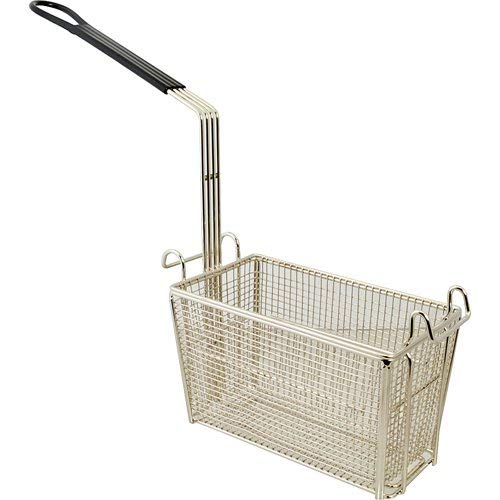
If your deep fryer basket just snapped a handle weld or the mesh started pulling away from the frame, you’re already facing the first decision every fryer operator hits sooner or later: do you go back to the original manufacturer for a replacement, or do you save money with an aftermarket part? A fryer basket is the wire or mesh insert that holds food while it cooks in hot oil — it’s the part that takes the most daily abuse and the part most likely to need replacing. OEM stands for Original Equipment Manufacturer, meaning the basket is made by or for the brand that built your fryer. Aftermarket means a compatible replacement made by a third party, sold to fit a range of models. The price difference can be $40 to $150 per basket. This article is going to show you exactly when that premium is justified — and when it isn’t — using Henny Penny and Carlisle as the case study, because they represent two very different points on the OEM spectrum.
| EDITOR'S PICK[Carlisle FoodService Products 1…](https://www.amazon.com/dp/B01CH9WLNK?tag=greenflower20-20) | Mid-tier[Carlisle FoodService Products C…](https://www.amazon.com/dp/B007QQWJQO?tag=greenflower20-20) | Budget pick[HENNY PENNY Short Fryer Basket…](https://www.amazon.com/dp/B01BKQWO2O?tag=greenflower20-20) | |
|---|---|---|---|
| Material | Chrome Plated Steel | Chrome Plated Steel | — |
| Handle Type | — | — | Vinyl-Coated |
| Size (Diam.) | — | 8.63" | — |
| Depth | — | 4.5" | — |
| Hooks Included | — | — | ✓ |
| Price | $63.37 | $39.99 | $39.13 |
| See on Amazon → | See on Amazon → | See on Amazon → |
What Makes Henny Penny and Carlisle Different from Generic OEM Brands
Henny Penny is a pressure and open-vat fryer manufacturer based in Eaton, Ohio, with a strong footprint in quick-service restaurant chains, grocery deli operations, and high-volume institutional kitchens. Their fryers — particularly the OFE and OFC open-fry series — are engineered around precise oil management and temperature consistency. The Henny Penny Corporation’s OFE/OFC Series Operator Manual specifies basket dimensions to tolerances that directly affect how the basket interacts with the fryer’s heat zones and oil return channels. This is not marketing language: if the basket sits too low or rides the bottom unevenly, you change the thermal dynamics of the cook.
Carlisle FoodService Products occupies a different position. Carlisle is primarily a foodservice supplies manufacturer — think bus tubs, trays, and steam table pans — but their 700 Series fryer baskets are specified as OEM-compatible components for several commercial fryer brands, not exclusively their own equipment. Per Carlisle FoodService Products’ basket specification sheets for the 700 Series, these are manufactured to 18/8 stainless steel (also written as 304 stainless), with documented wire gauge and NSF certification. Carlisle is, in practical terms, a well-spec’d aftermarket that has achieved enough industry penetration to be treated as a semi-OEM option in foodservice procurement.
Understanding that distinction matters before you ever open a purchase order.
The Three Scenarios Where OEM Is Actually Worth the Premium
1. Your Fryer Has Proprietary Basket Geometry
Henny Penny’s pressure fryers in particular use baskets with a specific lid-and-latch interaction. The basket has to seat correctly for the pressure seal to close safely. This is not a situation where “close enough” is acceptable. The Henny Penny OFE/OFC series documentation makes clear that basket specifications are tied to the fryer’s safety interlock system. An aftermarket basket that is 3mm shorter than spec can cause lid seating issues; one that is 2mm wider can bind the frame.
For any fryer where the basket physically interfaces with a pressure mechanism, a safety interlock, or a dual-basket counter-balance system, the OEM tolerance spec is load-bearing. You are not paying for a logo — you are paying for a part that was dimensioned against the actual fryer design files.
Decision rule: If your fryer manual specifies basket dimensions to the millimeter and ties basket fit to a safety or mechanical function, pay for OEM.
2. Your Operation Runs NSF Audit Risk
NSF/ANSI 2 (the Food Equipment standard maintained by NSF International) governs materials and construction for food-contact equipment in commercial kitchens. NSF certification on a basket means the materials, welds, and surface finish have been independently verified against that standard. The NSF International certification database is publicly searchable — you can look up a basket’s certification status by manufacturer and model number.
The risk with many low-price aftermarket baskets is not that they claim to be NSF-certified — it’s that the certification is on the product family, not the specific SKU you’re buying, or the certification has lapsed. Foodservice Equipment Reports has covered the pattern in high-volume operations where aftermarket baskets with questionable certification status created inspection exposure during health department audits.
Carlisle 700 Series baskets carry documented NSF certification traceable to specific models. Henny Penny OEM baskets carry the same. If you’re in a jurisdiction where your health inspector will ask to see documentation on non-original parts — or if you’re operating under a franchise agreement that requires OEM or NSF-certified-equivalent parts — the certification paper trail on a known brand is worth real money in avoided risk.
Decision rule: If you operate under franchise spec requirements, face regular NSF audits, or are in a high-inspection jurisdiction, use only baskets with traceable, current NSF certification. Both Henny Penny OEM and Carlisle 700 Series meet this bar. Many $25 aftermarket baskets do not.
3. You’re Replacing Into a Warranty Period or Service Contract
Commercial fryer warranties and service contracts frequently contain OEM-parts clauses. Using an aftermarket basket that causes a mechanical issue — a bent frame that damages the fryer’s basket guides, for example — can void warranty coverage on the fryer itself, which is a $3,000 to $12,000 asset depending on the model.
The Katom Restaurant Supply Blog’s OEM vs. aftermarket parts overview makes this point explicitly: the cost calculation on aftermarket parts always has to include the warranty-void scenario, especially in the first 12-24 months of equipment ownership.
Decision rule: If your fryer is under warranty or a service contract with an OEM-parts clause, use OEM baskets for the warranty period. After warranty expiry, re-evaluate.
The Scenarios Where Aftermarket Makes Rational Sense
High-Frequency Replacement in Volume Operations
A food truck running 10-12 service hours per day will wear out fryer baskets faster than a restaurant open 4 dinner hours. Operators in this category report basket replacement intervals of 6-9 months versus 18-24 months in lower-intensity operations, per Foodservice Equipment Reports’ coverage of replacement intervals in high-volume kitchens.
At a replacement interval of twice per year, the math on OEM versus a well-spec’d aftermarket shifts quickly:
By the numbers (twin-basket setup, annual cost):
- Henny Penny OEM replacement basket: ~$95–$130 per unit × 2 units × 2 replacements = $380–$520/year
- Carlisle 700 Series (NSF-certified, 304 SS): ~$55–$75 per unit × 2 units × 2 replacements = $220–$300/year
- Low-price aftermarket (unverified gauge, no traceable NSF cert): ~$20–$35 per unit × 2 units × 4 replacements (shorter lifespan) = $160–$280/year — but with inspection and weld-failure risk factored in, the effective cost is higher
The Carlisle tier often wins on this math: it delivers a documented material spec and NSF certification at a meaningfully lower price point than OEM, without the hidden risk carried by the cheapest tier. WebstaurantStore’s fryer basket buying guide notes that 304 stainless construction with a documented wire gauge is the minimum bar for commercial use — and Carlisle publicly specs to that bar.
Out-of-Warranty Equipment Where Fit Has Been Verified
For fryers that are 3+ years out of warranty and where you’ve confirmed dimensional compatibility by measuring the basket cavity yourself (length, width, depth, and handle clearance), a well-spec’d aftermarket from a supplier with traceable NSF documentation is a defensible procurement decision. The key phrase is “where fit has been verified.” Pulling the published basket dimensions from the manufacturer’s parts catalog and cross-referencing them against the aftermarket spec sheet is the minimum due diligence.
Decision rule: If the fryer is out of warranty, if you’ve done a published-spec cross-reference (not just “fits most models”), and if the aftermarket basket carries a traceable current NSF certification in 304 stainless, aftermarket is a rational choice.
The One Thing That Breaks Every Cost Calculation
Material misrepresentation is the single biggest risk in the fryer basket market, and it shows up in exactly the segment where buyers are already trying to save money.
201 stainless steel — a lower-grade alloy with higher manganese and lower nickel content than 304 — is frequently sold in fryer baskets marketed as “heavy-duty stainless” or “commercial grade” without specifying the alloy. In extended exposure to hot oil and salt, 201 stainless corrodes meaningfully faster than 304. Nickel-plated steel baskets, which look similar to stainless on the shelf, can begin to flake plating into the oil within months of regular use — a direct food safety concern.
Neither Henny Penny OEM nor Carlisle 700 Series baskets have this problem because their specs are publicly documented and the NSF certification process independently verifies material composition. The budget aftermarket tier does not provide that assurance by default.
When a supplier cannot name the steel grade in their spec sheet — or lists “stainless steel” without a grade designation — that is the signal to walk away, regardless of price.
The Decision Framework, Simplified
You have a current procurement decision. Here’s the if/then logic:
If your fryer is under warranty or a service contract with OEM-parts requirements → buy OEM.
If your fryer uses basket geometry that interfaces with pressure mechanisms or safety interlocks → buy OEM.
If you face regular NSF audits or franchise spec requirements → buy OEM or Carlisle 700 Series (documented NSF, 304 SS).
If your fryer is out of warranty, you’ve done a published-spec dimensional cross-reference, and your supplier can produce a current NSF certification for the specific SKU → aftermarket at the Carlisle tier or equivalent is defensible.
If a supplier cannot tell you the steel grade or point you to a traceable NSF listing → don’t buy it regardless of the price point.
The premium you’re paying for Henny Penny OEM or Carlisle-tier aftermarket is not brand loyalty — it’s documentation, material traceability, and mechanical fit. In a commercial kitchen running hundreds of cycles per week, those three things are worth real money. The question is always whether your specific operation’s risk profile makes the OEM number the right number, or whether a well-documented aftermarket closes the gap without opening new exposure. Work the decision tree above against your actual situation, and the answer gets cleaner than the marketing usually makes it look.