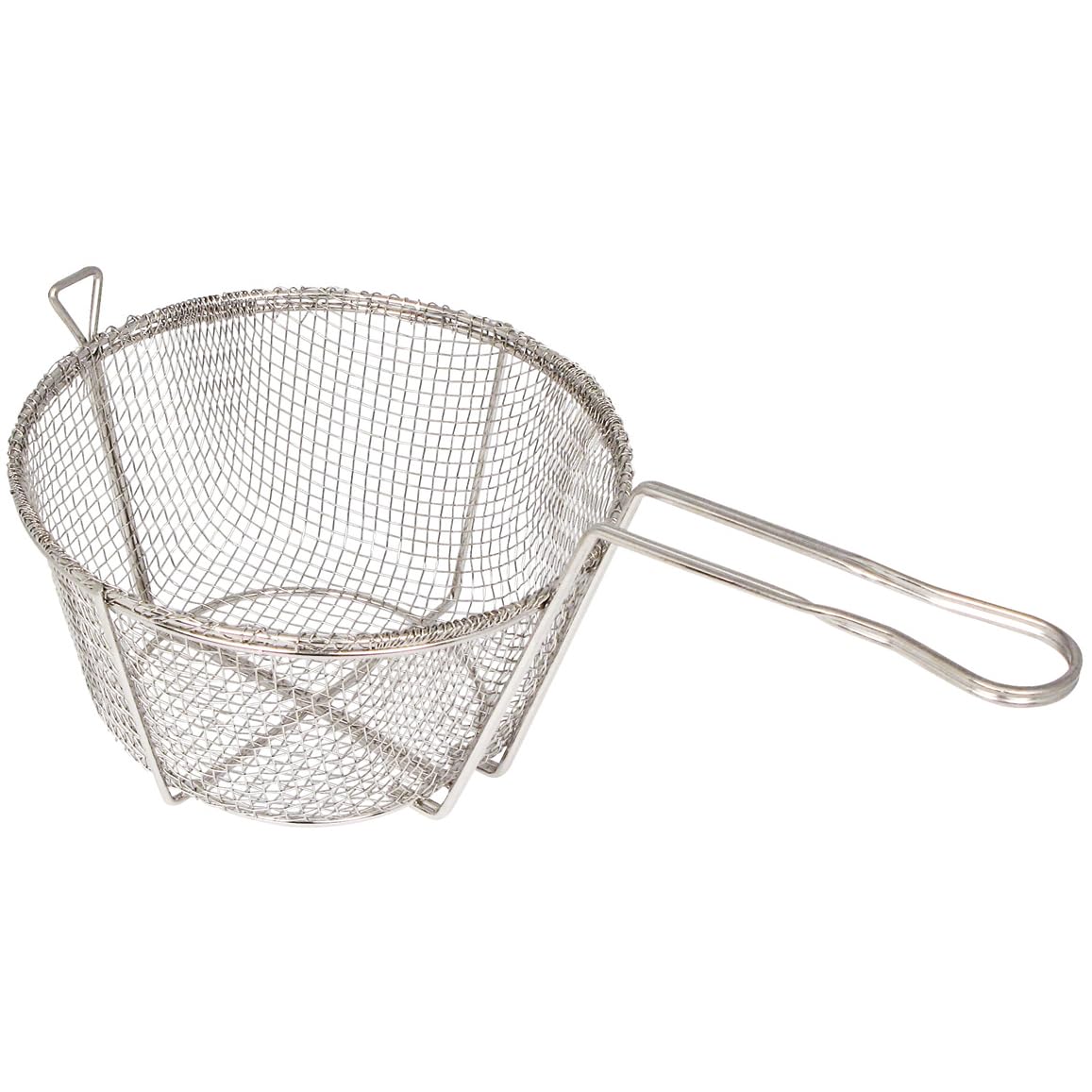
If the basket that came with your countertop fryer or stovetop setup has finally given out — or if you’re just realizing that the one-size-fits-all replacement you ordered online doesn’t actually sit right in the pot — you’re in the right place. A round wire fry basket is exactly what it sounds like: a bowl-shaped basket made from a grid of metal wire, designed to lower food into hot oil and lift it back out cleanly. Unlike the rectangular twin-basket setups you see in commercial kitchens, round baskets are built for home fryers with cylindrical bowls and for stovetop frying in Dutch ovens or deep stockpots. The tricky part is that “round” covers a huge range of sizes, wire gauges, and mesh configurations — and the wrong combination means food slips through, sticks to the wires, or the basket warps after six uses. This guide breaks down what actually matters: mesh opening size, basket depth, diameter fit, and how those specs interact with the specific foods you’re frying.
| EDITOR'S PICK[Lodge Silver Deep Fry Basket](https://www.amazon.com/dp/B000050AV5?tag=greenflower20-20) -… | Mid-tier[Lodge Deep Frying Basket](https://www.amazon.com/dp/B00063RXPG?tag=greenflower20-20) | Budget pick[HIC Kitchen Fry Basket](https://www.amazon.com/dp/B005L9ZCOY?tag=greenflower20-20) | |
|---|---|---|---|
| Diameter | 11.5" | 9" | 7" |
| Depth | 10.25" | — | — |
| Material | Nickel-plated steel | — | 18/8 Stainless steel |
| Finish | Nickel-plated | — | — |
| Price | $29.99 | $24.90 | $14.99 |
| See on Amazon → | See on Amazon → | See on Amazon → |
Why Round Baskets Are Their Own Category (and Why Fit Matters More Than You Think)
Most home fryer buyers don’t think carefully about basket geometry until they’re standing in the kitchen with a replacement that’s either too narrow to sit on the pot rim or too wide to submerge past the oil line. Round baskets are designed around a fundamentally different form factor than the rectangular commercial-style baskets: they hang or rest by a rim or hook above a cylindrical vessel, and their entire load capacity depends on a stable, level seat at the top of the pot.
The fit variables that matter here are:
- Outer diameter — the measurement of the basket’s rim, which must clear the inside of the fryer bowl or pot opening
- Inner diameter — the usable frying space
- Depth — how far the basket extends into the oil
- Mesh opening size — the gap between individual wires, measured in millimeters or fractions of an inch
Per the WebstaurantStore blog’s overview of fryer basket types, round baskets for home use typically range from about 6 inches to 10 inches in outer diameter. That sounds like a wide range, but a half-inch error on either end will prevent a proper rim-rest fit on most countertop fryers. If the basket sits too shallow, it won’t submerge enough food. If it wedges too tight, getting it out safely mid-fry becomes genuinely dangerous.
The KaTom blog’s deep fryer basket buying guide also flags a detail most product listings bury: the difference between baskets that hang from a hook at the rim versus those that rest on a ledge inside the pot. This matters because a hook-hang basket needs clearance above the oil line, while a ledge-rest basket’s outer diameter has to match a specific ledge width — and those two designs are not interchangeable even if the diameter appears similar.
Mesh Size: The Variable That Controls What You Can Fry
This is the decision point most buyers skip, and it’s the one that causes the most post-purchase frustration. Mesh opening size — the actual gap between wires — determines what can fall through the basket and what can’t.
The general breakdown by food type:
Large-opening mesh (roughly 12–18mm between wires): Appropriate for whole chicken pieces, bone-in wings, large fish fillets, corn dogs, and donuts. The food is big enough that nothing falls through, and the wider openings allow maximum oil circulation for even browning. Owners of baskets in this category consistently report better crust development on wings because the oil reaches the food from more angles.
Medium-opening mesh (roughly 8–12mm): The sweet spot for most home fryers. Works well for cut fries (standard or steak-cut), shrimp, calamari rings, onion rings, and breaded items. This is what most “universal” replacement baskets are built around, and Serious Eats’ equipment coverage consistently notes that home fryers in the 1–3 liter range are optimized around food portions that fit this mesh window.
Fine-opening mesh (roughly 4–8mm): Required for small items: thin shoestring fries, small breaded vegetables, small scallops, popcorn shrimp. If you’re frying anything with a crumb coating that can flake off during cooking, finer mesh helps catch those pieces before they burn in the oil and contaminate the next batch. The Spruce Eats’ fryer guide notes that fine-mesh baskets are especially useful for Asian-style frying applications where small, delicate items are common.
The math reality check:
| Food type | Minimum mesh opening | What falls through a too-coarse basket |
|---|---|---|
| Shoestring fries | ~5–6 mm | Thin end pieces, crumb bits |
| Popcorn shrimp | ~4–5 mm | Small shrimp, breading |
| Bone-in wings | 12+ mm fine | Nothing — coarse mesh works |
| Breaded fish | 8–10 mm | Coating flakes, thin end edges |
The tradeoff is real: a finer mesh that prevents food loss also restricts oil flow slightly and is significantly harder to clean. If you’re frying large, unbreaded items exclusively, a fine-mesh basket is just extra work. If you’re frying a variety and want one basket to handle it all, the 8–10mm medium range is the defensible default.
Depth: Shallow vs. Deep Baskets and the Oil-Level Equation
Basket depth is the spec that most replacement buyers get wrong because they’re measuring the pot, not the oil level inside it.
The rule: usable basket depth should not exceed your working oil depth by more than about 1 inch. If your fryer or pot holds 3 inches of oil at operating level, you want a basket that reaches roughly 2–2.5 inches below the rim, not 4 inches. A basket that’s too deep will sit with its bottom resting on the pot floor, which means food burns on the bottom instead of floating in oil.
Most home stovetop setups — Dutch ovens, deep stockpots — run at 3–4 inches of oil when used for frying, per general guidance from Serious Eats’ frying methodology coverage. That means the ideal stovetop round basket is in the 3–4 inch depth range, with rim hooks or a wide rim that clears the pot opening.
For countertop home fryers, the fryer’s own spec sheet is the correct reference. Manufacturers like Presto, T-fal, and Hamilton Beach publish bowl dimensions in their product documentation. A basket rated for a T-fal 1.2-liter fryer (typically around 6.5–7 inch outer diameter, 3–3.5 inch depth) won’t work well in a Presto FryDaddy setup with a shallower bowl geometry — even though both are “home round fryers” in the same price tier.
The depth tradeoff in plain terms:
- Too shallow: food crowds the top of the basket, fries unevenly, and you can only fry in small batches
- Too deep: basket rests on pot floor, food burns underneath, harder to monitor oil temperature
- Right depth: food floats freely, basket rim rests stably at the pot edge, oil surrounds the food on all sides
Wire Gauge and Material: What “Heavy-Duty” Actually Means
This is where material honesty matters most for buyers in the $15–$50 range.
Wire gauge refers to the thickness of the individual wires that form the basket. Lower gauge numbers mean thicker wire (this is the same convention used for sheet metal and electrical wire). Most home-grade round baskets are built from 2.0–3.5mm wire. Anything under 2mm will flex visibly when loaded with wet, heavy food — whole chicken pieces, dense root vegetables — and may warp permanently after repeated high-heat cycles.
On stainless steel grades: The KaTom buying guide and WebstaurantStore blog both flag the 201 vs. 304 stainless distinction as a significant purchasing consideration. 304 stainless steel contains roughly 18% chromium and 8% nickel, giving it strong corrosion resistance against acidic foods, salt, and the repeated oil exposure that fry baskets endure. 201 stainless substitutes manganese for some of the nickel content and is meaningfully less corrosion-resistant — it holds up fine in dry conditions but will show pitting and surface rust faster under continuous fry-oil exposure.
The problem: many listings in the $12–$25 range describe their product as “stainless steel” without specifying 201 or 304. Nickel-plated steel baskets — which have an even thinner protective layer — are sometimes sold with similar language. Aggregated owner reviews on home fryer baskets consistently surface rust complaints at the 6–12 month mark on baskets that were marketed as stainless but appear to be 201 or nickel-plated based on failure patterns.
What to look for: Listings that specify “304 stainless” or “18/8 stainless” (18/8 is another way of writing the chromium/nickel ratio for 304). If the listing doesn’t specify, that’s diagnostic information in itself.
Matching the Basket to Your Actual Use Case: The Decision Frame
You’re choosing between configurations, not just products. Here’s how to run the decision:
If you’re frying large, irregular items (whole wings, drumsticks, fish fillets): Prioritize diameter and depth over mesh fineness. A large-opening mesh (12mm+) with a diameter that gives you 1–2 inches of clearance from the pot wall will outperform a fine-mesh basket in oil circulation and crust quality. Don’t pay extra for fine mesh you don’t need.
If you’re frying small or breaded items (shrimp, thin fries, anything with a coating): Fine mesh (5–8mm) is worth the cleaning tradeoff. Calculate whether your pot can support the oil depth that the basket requires — stovetop pots often need more oil than buyers expect to actually submerge a fine-mesh basket properly.
If you’re buying a replacement for a named countertop fryer: Start with the manufacturer’s published bowl dimensions, not the “universal fit” claim in the product listing. Universal baskets are engineered to fit a range — which means they fit none of them perfectly. For a fryer you plan to use weekly, the extra research to find a spec-matched replacement is worth the 20 minutes.
If you’re frying over a stovetop without a dedicated fryer: A basket with a wide, flat rim or hook system that seats stably on your pot diameter is the first filter — everything else is secondary. An unstable basket in hot oil is a safety issue, not a performance issue.
If budget is the real constraint ($12–$22 range): Prioritize 304 stainless specification over mesh fineness or wire gauge. A thin-wire 304 basket will outlast a heavy-looking nickel-plated basket in actual fry conditions. Ask for the steel grade in the product listing before you buy; if it’s not specified, that’s a red flag.
The round wire basket market in mid-2026 is saturated with listings that use “heavy-duty,” “commercial-grade,” and “professional” as marketing language without backing those claims with published material specs. The buyers who get the most useful life out of their baskets are the ones who treat the spec sheet — not the product photo — as the primary document. Diameter, depth, mesh opening, wire gauge, and steel grade: five numbers that tell you more than any headline claim.