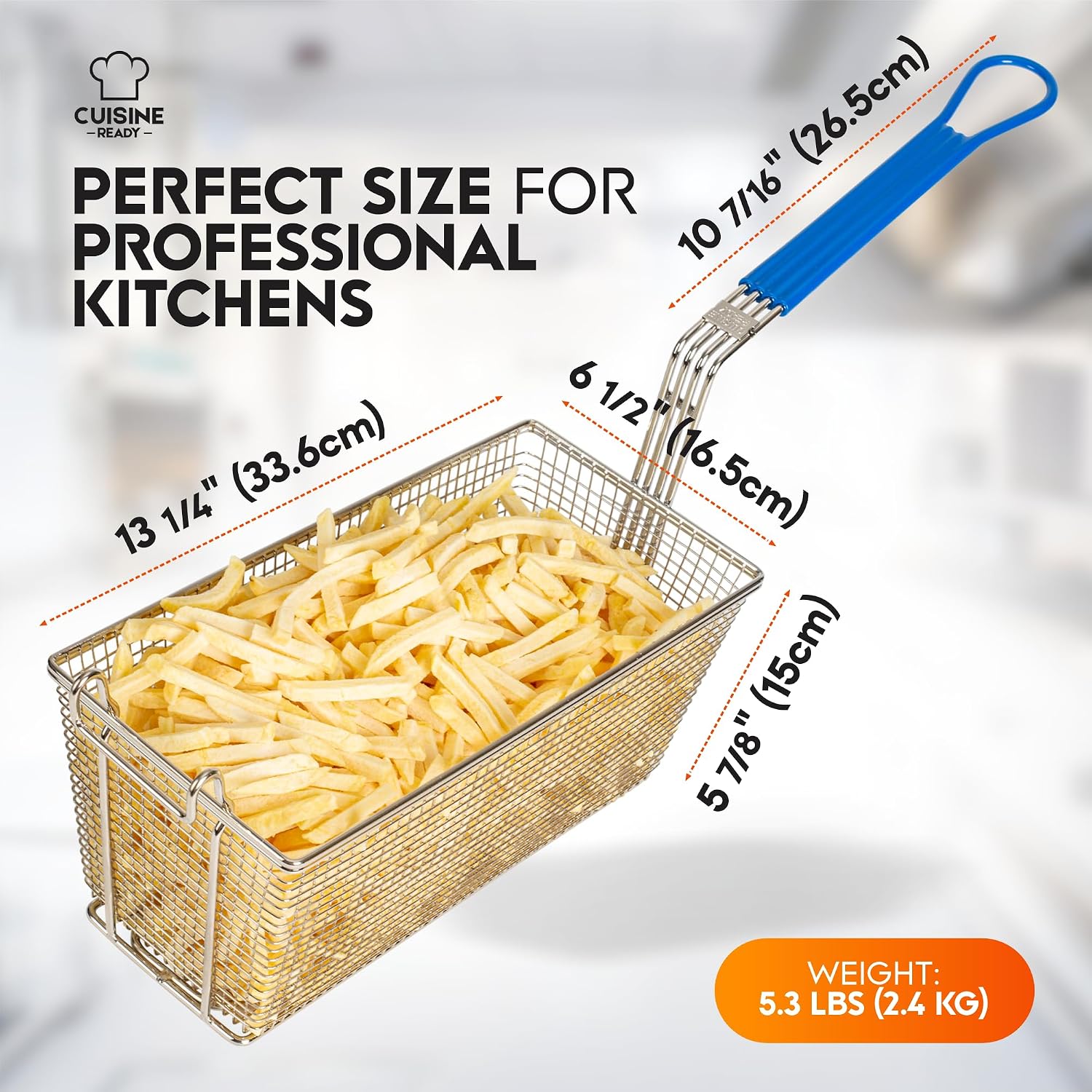
Your fryer basket just gave up — a cracked handle weld, a buckled mesh, or a hinge that finally snapped after one shift too many. You search for a replacement, and within about thirty seconds you’re staring at a product listing that says “Universal Fit — 13.25 x 6.5 inches, compatible with most countertop and commercial fryers.” Sounds simple. It usually isn’t. A deep fryer basket (the metal mesh container that holds your food as it cooks in hot oil) is not a universal object — even when the outer footprint matches, variables like mesh opening size, hook style, handle angle, wire gauge, and the all-important clearance inside the fryer vat can mean the difference between a basket that works perfectly and one that jams, tips, or scorches your food from the bottom. This article breaks down every dimension that actually matters, maps them against published specs for the most common fryer brands, and gives you a clear decision rule so you don’t order the wrong thing twice.
Why “13.25 x 6.5” Is Only Half the Story
The outer footprint dimension — length by width — is what every aftermarket listing leads with, and it is genuinely useful as a first filter. But it does not tell you whether the basket will sit at the right depth inside your vat, clear the heating elements, or hang securely from the fryer’s basket rail.
Here are the four dimensions that actually matter for fit, ranked by how often they cause problems:
1. Interior depth (basket height). This is how deep the basket sits into the oil. Too shallow and your food floats out or fries unevenly at the top. Too deep and the basket bottom contacts the heating elements or the vat floor — a fire hazard and a fast way to ruin a mesh. The KaTom Restaurant Supply Blog’s deep fryer basket buying guide explicitly flags depth mismatch as the most common reason for aftermarket returns in the commercial segment. Depths on baskets nominally labeled “13.25 x 6.5” typically range from 4.5 inches to 6 inches depending on the product line.
2. Hook geometry and rail clearance. The hook is the curved or straight metal piece at the top rear of the basket that rests on the fryer’s side rail when you’re draining. Hook height, hook offset, and hook angle vary by OEM design. A Pitco SG-series fryer, for example, uses a side-rail depth of approximately 3.25 inches measured from the top of the vat wall; a hook designed for a Vulcan 1VK45 sits at a shallower offset and will rock or tip in a Pitco vat. Per the Pitco Frialator OEM Parts Catalog, replacement basket hooks are explicitly dimensioned for specific vat configurations — they are not interchangeable across the Pitco SG, SSH, and SGM series without verification.
3. Mesh opening size. The gap between wires determines what foods pass through and what stays in. A 3/16-inch mesh holds thin-cut fries fine but will let small breaded shrimp or tater tot fragments fall through. A 1/4-inch mesh is common on commercial twin-basket configurations and works for most proteins but is too open for funnel cake batter fragments or fried herb garnishes. Aftermarket listings frequently omit this spec entirely — which is a red flag.
4. Wire gauge and frame construction. This one is a material honesty issue the site takes seriously. Listings for baskets “made of heavy-duty stainless steel” may be referring to 201-grade stainless (higher manganese, lower nickel, more corrosion-prone under repeated acid exposure from frying oils) or nickel-plated steel rather than food-service-grade 304 stainless. The WebstaurantStore Blog’s fryer basket guide notes that NSF-certified baskets are required to meet NSF/ANSI 8 standards for commercial powered food preparation equipment, which includes material and finish requirements that 201-grade and nickel-plated products frequently cannot meet. If your purchase is for a commercial or foodservice context, the NSF mark is not optional.
By the Numbers: Nominal vs. Actual Dimensions on Common Fryer Models
The table below is compiled from published OEM specification documents. These are not measurements taken in the field — they are manufacturer-published figures, and you should verify against your specific model number before ordering.
| Fryer Model | Vat Interior Width | Recommended Basket OD Width | Basket Depth (OEM) | Hook Style |
|---|---|---|---|---|
| Pitco SG14 | 14.0 in | 13.25 in | 5.75 in | Side-hang, 3.25 in offset |
| Frymaster MJ35 | 14.0 in | 13.25 in | 5.25 in | Side-hang, 3.0 in offset |
| Vulcan 1VK45 | 15.5 in | 13.5 in | 5.5 in | Side-hang, shallow offset |
| Waring WDF1550 (countertop) | 13.5 in | 13.0 in | 4.75 in | Front-hang, fixed |
| Cuisinart CDF-500 (countertop) | 12.0 in | 11.5 in | 4.5 in | Fixed-mount |
Read this table carefully before you buy: The Pitco SG14 and Frymaster MJ35 share a nominal 13.25-inch basket width, but their basket depth specs differ by half an inch and their hook offsets differ by 0.25 inches. A basket spec’d for the Frymaster MJ35 installed in a Pitco SG14 vat may sit too high — meaning the bottom quarter of your food is undercooked relative to OEM design. Frymaster’s published parts guide distinguishes MJ35 baskets from MJCF baskets expressly on depth, not footprint.
The Vulcan 1VK45 nominally takes a wider basket (13.5 inches) despite a 15.5-inch vat interior — that 2-inch clearance gap is intentional for thermal expansion and oil circulation per the Vulcan Food Equipment Group replacement parts specification. An aftermarket listing claiming “fits Vulcan” based on the 15.5-inch vat measurement alone would be incorrect by a full inch.
The Commercial Operator’s Tradeoff: OEM vs. Aftermarket
Here is the honest version of the math as of mid-2026:
An OEM replacement basket for a Pitco SG-series fryer runs approximately $95–$145 per unit depending on supplier and whether you’re sourcing direct or through a parts distributor. A well-spec’d aftermarket basket claiming the same dimensions from a reputable foodservice supply house runs $45–$75. The spread is real. The question is what you’re buying with the premium.
What OEM actually gets you:
- Documented model-specific hook geometry matched to the rail design your fryer was engineered with
- NSF certification tied to that specific basket SKU (not a generic claim)
- Manufacturer warranty coverage that won’t be voided by a basket substitution if something goes wrong with the vat
- Wire gauge and mesh spec that match the fryer’s rated oil circulation pattern
What a good aftermarket basket can legitimately offer:
- NSF/ANSI 8 certification on its own terms — the certification is not OEM-exclusive, and several aftermarket suppliers do hold it. Per NSF International’s database of certified products, certification is issued to individual products, not manufacturers, meaning an aftermarket basket can be legitimately NSF-certified
- 304-grade stainless construction at lower price points than OEM
- Acceptable fit on high-volume workhorse fryer models where aftermarket dimensions have been reverse-engineered with precision
What aftermarket frequently cannot offer:
- Hook geometry verified against your specific vat rail — most aftermarket listings give you the footprint and depth but omit the hook offset
- Mesh opening size specification
- Any documentation on the stainless grade used
The practical decision rule: if you’re running a Pitco, Frymaster, or Vulcan in a commercial kitchen with more than one fryer, the cost-per-use math on OEM starts to favor you at the 18-month mark when you factor in the avoided downtime cost of a basket that tips, jams, or corrodes prematurely. If you’re running a single countertop unit in a ghost kitchen or food truck at moderate volume, a well-sourced aftermarket basket with documented NSF certification and a stated 304-stainless construction is a reasonable call — provided you verify the hook spec before you order.
How to Actually Verify Fit Before Ordering
This is the part most buyers skip, and it’s where returns and frustration originate.
Step 1: Pull your fryer’s model number and look up the OEM basket SKU. The model number is on the serial plate, usually on the back or side of the unit. Cross-reference it against the OEM parts catalog — Pitco, Frymaster, and Vulcan all publish parts catalogs on their official sites. This gives you the OEM basket part number and its published dimensions, which become your verification benchmark.
Step 2: When evaluating an aftermarket listing, require four numbers, not two. Footprint (length × width), basket depth, and hook offset. If the listing doesn’t publish all four, contact the supplier and ask. If they can’t provide the hook offset, that’s a signal.
Step 3: Check the NSF certification independently. NSF International maintains a searchable database of certified products at nsfcertified.org. If an aftermarket supplier claims NSF certification, find the SKU in that database before you buy. “NSF-grade materials” and “NSF certified” are not the same claim.
Step 4: Verify the stainless grade explicitly. Ask for the material spec sheet or look for a listing that states 304 stainless unambiguously. “High-grade stainless” and “commercial-grade stainless” are marketing language, not metallurgical specifications.
Step 5: For twin-basket setups, verify that two baskets of the specified width can operate simultaneously without contact. Some fryer vats are dimensioned for twin-basket use with OEM baskets precisely; two aftermarket baskets at nominal width may rub or bind if the outer dimensions run slightly wide of spec on the plus side of tolerance.
The Decision Rule
If you’re replacing a single basket on a consumer or prosumer countertop fryer (Waring WDF1550, Cuisinart CDF-500, and equivalents), a universal basket in the correct footprint dimension is a reasonable option — these fryers have simpler hook geometries and more forgiving clearances. Prioritize 304 stainless over nickel-plated, and confirm the mesh opening size matches what you fry most.
If you’re replacing baskets on a named commercial fryer (Pitco, Frymaster, Vulcan, Manitowoc), start with the OEM part number and treat it as your default unless the price delta and a verified aftermarket spec sheet give you a clear reason to deviate. The half-inch of depth or the quarter-inch of hook offset that separates “close enough” from “actually fits” is not visible in a product photo and is rarely disclosed in a generic listing title.
The word “universal” in a basket listing is a marketing claim, not an engineering specification. Treat it accordingly, pull the actual numbers, and your replacement basket will earn its keep. Skip the spec check, and you’ll be back on the listing page inside three weeks.